
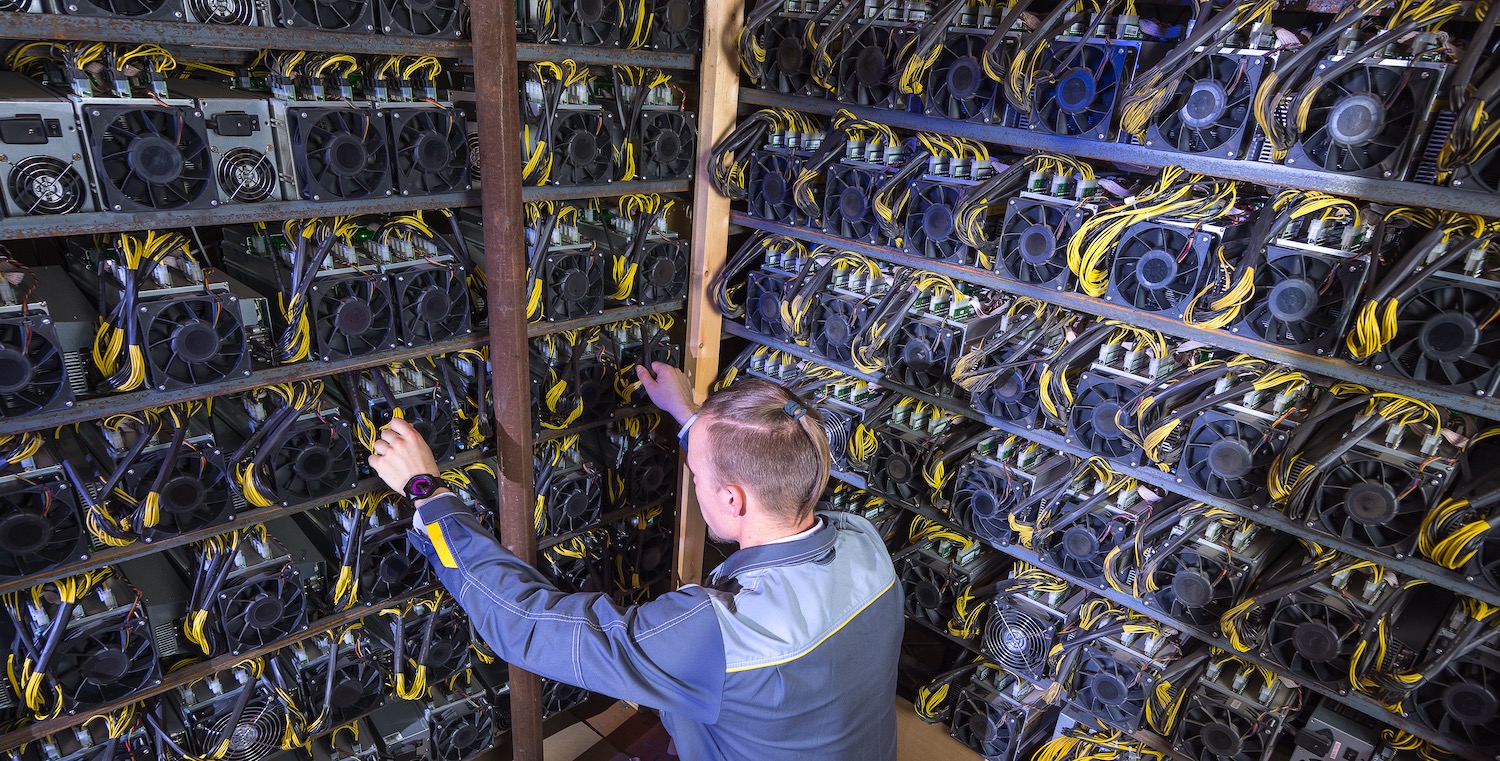
Bitcoin mining is a process whereby new transactions for the Bitcoin currency system are verified on the Bitcoin blockchain and as a result, new Bitcoins are released into circulation.
The transactions carried out within the currency system are recorded on the Bitcoin blockchain in the form of blocks. A continuous chain of blocks forms the well-known blockchain. The blockchain contains the records of past transactions.
Miners use software to solve algorithms related to transactions. These algorithms have the task of checking the transactions. The solution of these complex arithmetic operations is rewarded by the Bitcoin network in the form of new Bitcoins for the miner.
How does bitcoin mining work?
Bitcoin mining involves solving complex mathematical tasks to verify transactions on the Bitcoin blockchain. The miners receive the transaction data from the blockchain and run it through a cryptographic algorithm. A so-called hash is generated, which is integrated into the next block.
Bitcoin Mining
In this article , we have described the Bitcoin mining process in a little more detail. In general, one can say that this process requires specific hardware, know-how and high energy consumption. In the past, many individual miners could mine from home and earn bitcoins as rewards. As the length of the blockchain increases, mining becomes more and more difficult and expensive as the amount of data keeps increasing.
Is mining bitcoin getting harder?
The process of mining bitcoin in 2022 is much harder than it was 10 years ago. We have already mentioned that Bitcoin mining becomes more and more complex with the length of the blockchain. Because a longer blockchain means that more and much more complex data has to be processed.
What makes it even harder for "small" miners to mine bitcoin these days is the lower rewards for mining in the wake of bitcoin halvings. A bitcoin halving is the event where the reward for creating a new block on the blockchain is halved.
Bitcoin Mining
The structure of the Bitcoin blockchain is designed for Bitcoin to become a deflationary asset over time. Because of the increased difficulty of mining and the lower rewards over time, it becomes more and more difficult to mine Bitcoin. In total, only 21 million bitcoins can be created in total. As a finite and rare commodity, the value of Bitcoin should increase massively in the future.
What does Bitcoin Halving mean for Bitcoin mining?
As already mentioned, the halving events, which occur about every 4 years, mean that Bitcoin mining is becoming less and less worthwhile, especially for small, individual miners. The fact that it is becoming increasingly difficult for individuals to mine Bitcoin over time is due to the structure of the Bitcoin blockchain. The concept of the Bitcoin inventor Satoshi Nakamoto provides that the difficulty increases in order to keep the Bitcoin deflationary.
With each halving, the reward for mining new bitcoins is halved. In recent years, the rewards have halved several times:
28.11.2012: 1. Halving – 50 BTC -> 25 BTC
09.07.2016: 2. Halving – 25 BTC -> 12,5 BTC
11.05.2020: 3. Halving – 12,5 BTC -> 6,25 BTC
The next Bitcoin Halving will occur in 2024. In this article , we will discuss in more detail about the next bitcoin halving.
How long will it take to mine Bitcoin in 2022?
We have previously described the Bitcoin mining process. But how long will it take to mine a bitcoin in 2022?
This question is easy to answer: Regardless of the number of miners, a new block must be added to the Bitcoin blockchain every ten minutes. Bitcoin mining is therefore more of a huge competition. There are hundreds of thousands of miners on the Bitcoin network who ensure that new blocks are added. An important value for the effectiveness of mining activities is the Bitcoin hash rate. You can find out more about this parameter here.
With the current blockchain, it would take an individual miner far too long to perform the necessary calculations and add a new block. Therefore, many miners have joined forces in recent years to achieve higher computing power. This is how large mining farms were created, which use massive computing power.
Bitcoin Mining
Due to the increasing difficulty and lower rewards in mining, it is now only worth mining Bitcoin if you are part of a large corporation or part of a mining farm as a miner. The required computing power is simply too high for the individual miner.
Is mining still going on after 21 million Bitcoins have been created?
Yes, even after creating 21 million bitcoins, miners can still get rewards from the Bitcoin blockchain. However, they will then no longer receive “block rewards” for creating new blocks. However, they still receive the fees for validating Bitcoin transactions.
Mining will therefore also play an extremely important role for the Bitcoin blockchain in the years and decades to come. This requires increasing computing power. It is therefore up to the large groups of miners to maintain the hash rate of Bitcoin.
My Top PicksHoneygain - Passive earner that pays in BTC or PayPalMandalaExchange -The Best no KYC crypto Exchange!
BetFury - Play And Earn BFG for daily Bitcoin and ETH dividends!
Pipeflare - Faucet that pays in ZCash and Matic, Games pay in DAIWomplay - Mobile dApp gaming platform that rewards in EOS and BitcoinCointiply - The #1 Crypto Earning SiteLiteCoinPay -The #1 FaucetPay earner for LitecoinLBRY/Odysee - YouTube Alternative that lets you earn Money by viewing videos!FaucetPay - The #1 Microwallet PlatformFREEBTC - The #1 FaucetPay earner for Satoshi'sFaucetCrypto - An earning/faucet site that pays out instantlyFireFaucet - An earning site that pays better for some than Cointiply
DogeFaucet - Dogecoin Faucet
xFaucet - BTC, ETH, LTC, Doge, Dash, Tron, DGB, BCH, BNB, ZEC, FEY - Claim every 5 minutes
Konstantinova - BTC, ETH, LTC, Doge, Dash, Tron, DGB, BNB, ZEC, USDT, FEY, 25 Claims Daily
Comments
Post a Comment