
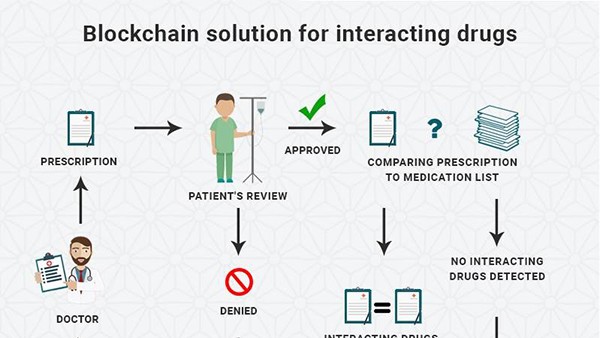
The EU Blockchain Observatory has presented its fifth research report on "Blockchain Applications in Healthcare". The document explicitly highlights the potential of distributed ledger technology (DLT) for the European healthcare industry, which is facing a number of challenges on the way to "Healthcare 4.0".
The 66-page report was published on April 11 by the EU Blockchain Observatory on Twitter. Overall, the authors of the study are confident about the adoption of blockchain technology in healthcare, as it is particularly compatible with the fundamental innovations in "Healthcare 4.0", including interoperability, virtualization, decentralization, real-time functionality, service orientation and modularity . The seven most important findings of the study are:
Old system, new challenges
The more knowledge-based the healthcare industry becomes, the more complex it becomes at the same time. The continuous emergence of new methods and procedures therefore makes them prone to errors. It is all the more important to have flexible and digitized databases available. Such systems should also be easy to understand and user-friendly for patients who want to see their personal health data.
In addition, there is still the well-known problem that information in the healthcare industry is often separated from one another in data silos. In this context, the research report comes to the conclusion that data systems based on distributed ledger technology could solve many of the problems mentioned above.
Sensible centralization
In healthcare, meaningful centralization is desired, but effective centralization is difficult to achieve for a variety of reasons. The DLT could help here. As the blockchain report explains, distributed ledgers could, for example, record the use of medical technology within hospitals and practices to show needed or free capacity and refer patients to the best treatment facilities for them.
Effective fight against counterfeiters
Perhaps one of the biggest benefits of blockchain in the healthcare industry is its ability to effectively combat counterfeit medicines. A topic that has always plagued the industry. The technology could help to document every step along the supply chain and make it traceable. This would also bring advantages on a logistical level:
"Blockchains could serve as databases to prove the authenticity of vaccines and essential medicines by tracking their journey from manufacture to issue, which would drastically reduce the risk of mis-dispensing and counterfeiting."
This factor could weigh all the more heavily, especially in pandemic emergencies such as the world population experienced until recently.
Global blockchain
The health of the world's population is one of the few issues on which there is the greatest possible cooperation at the global level. Here, too, blockchain technology can play an important role in optimizing data exchange.
As in the tech industry, artificial intelligence (AI) and machine learning are also the future in healthcare. The effective collation of information across different healthcare facilities is the basic prerequisite for building targeted algorithms for machine learning:
"The blockchain solves the problem of federal information distribution, it can ensure fairness and promote cooperation between healthcare institutions by turning local models into global models, because it enables problem solutions to be exchanged without having to exchange concrete data."
privacy
The research report expresses doubts that the blockchain alone can provide sufficient protection for patient data, because once it is recorded on the distributed ledgers, it can no longer be deleted. The authors therefore propose that the blockchain is combined with off-chain solutions to solve this problem:
"In order to comply with the EU data protection regulation, blockchain applications could be connected to higher-level databases so that the exchange of necessary data can be processed on the blockchain, while the actual patient data is stored outside of it."
An encouraging conclusion
Overall, the authors of the study come to the conclusion that they expressly call on the European Commission to continue to create the framework conditions so that technical innovations in healthcare, such as blockchain technology, can be promoted. In this regard, they emphasize that DLT not only offers a new type of technical infrastructure, but also shows a completely new way of handling data and at the same time opens doors for economic development.
The researchers see a possible threat to blockchain innovations in politics, because they could slow down implementation with particularly conservative regulatory proposals. Accordingly, regulatory measures would have to be reviewed regularly so that they can take into account the latest knowledge about DLT in the political debates.
“Oversight of decentralized blockchain technology requires a fresh perspective and ongoing education to understand how to embed this technology in current and future regulatory frameworks.”
The European Blockchain Observatory is an initiative commissioned by the European Commission to drive European innovation in blockchain and stimulate debate on distributed ledger technologies in EU member states.
My Top PicksHoneygain - Passive earner that pays in BTC or PayPalMandalaExchange -The Best no KYC crypto Exchange!
BetFury - Play And Earn BFG for daily Bitcoin and ETH dividends!
Pipeflare - Faucet that pays in ZCash and Matic, Games pay in DAIWomplay - Mobile dApp gaming platform that rewards in EOS and BitcoinCointiply - The #1 Crypto Earning SiteLiteCoinPay -The #1 FaucetPay earner for LitecoinLBRY/Odysee - YouTube Alternative that lets you earn Money by viewing videos!FaucetPay - The #1 Microwallet PlatformFREEBTC - The #1 FaucetPay earner for Satoshi'sFaucetCrypto - An earning/faucet site that pays out instantlyFireFaucet - An earning site that pays better for some than Cointiply
DogeFaucet - Dogecoin Faucet
xFaucet - BTC, ETH, LTC, Doge, Dash, Tron, DGB, BCH, BNB, ZEC, FEY - Claim every 5 minutes
Konstantinova - BTC, ETH, LTC, Doge, Dash, Tron, DGB, BNB, ZEC, USDT, FEY, 25 Claims Daily
Comments
Post a Comment