
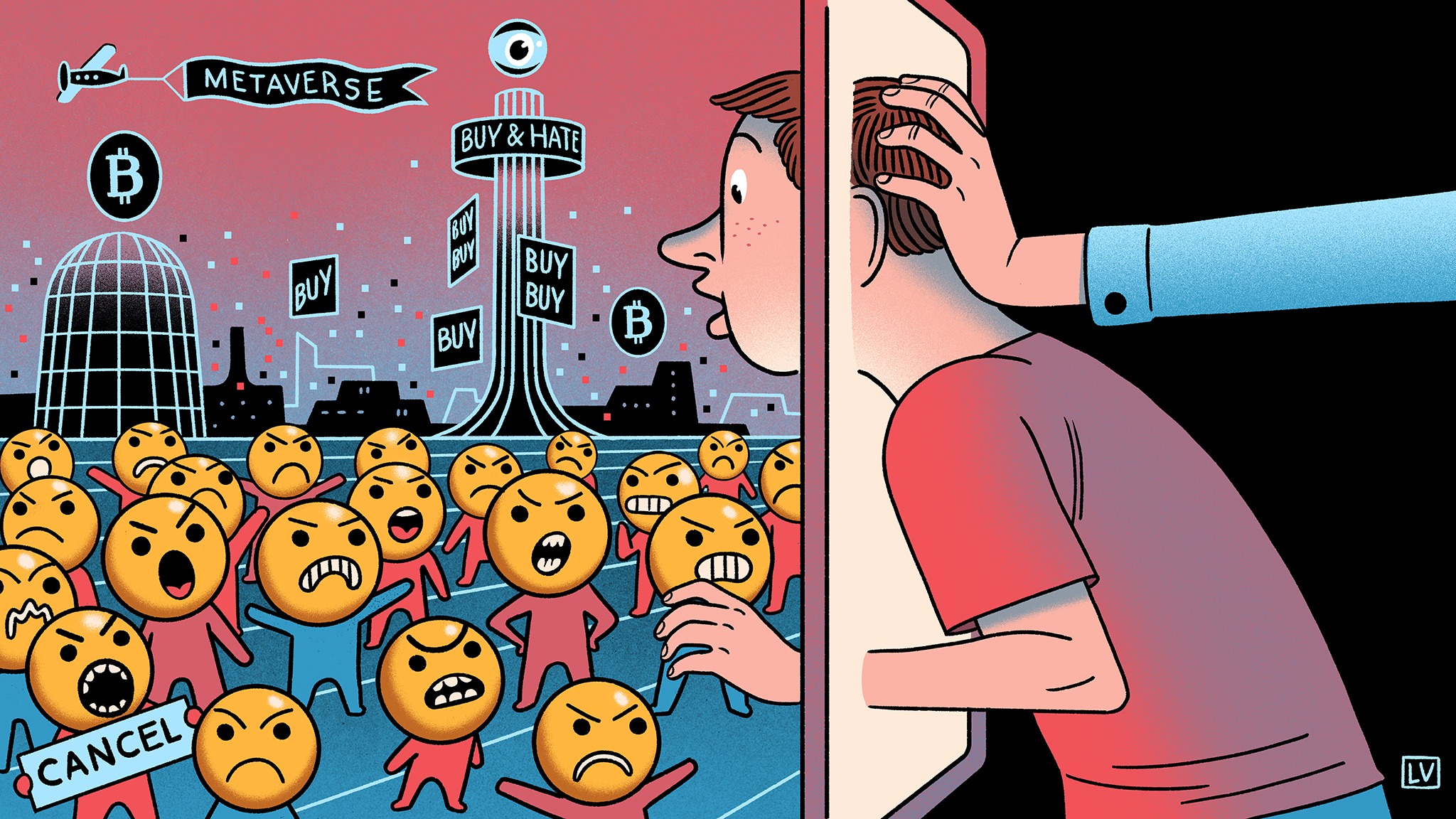
Although the Metaverse is still in development, the big tech companies and crypto platforms are already competing for market share in the digital economy. Whether there will be a major redistribution in virtuality or whether the platform monopolies of the big techs will ultimately be the winners depends on the users.
During the 19th-century gold rush, thousands of fortune hunters flocked to America's West Coast, building villages that became cities and eventually metropolises - like San Francisco - and left behind ghost towns in search of El Dorado. The boomtowns, some of which are still intact today, tell stories of the desire for prosperity, of rise and fall, the prospect of a better life and the bitter realization of having hunted a ghost. Most El Dorados turned out to be mirages.
200 years later, the search for the new El Dorado has begun: the metaverse, the virtual space in which the boundaries between the physical and the digital are blurred by augmented and virtual reality processes (AR/VR), new economies and networks are emerging, is expanding Relocate parts of social life - and the big techs ram their pickaxes.
Who comes first…
Microsoft has let the future business with the takeover of Activision Blizzard cost 69 billion US dollars , while Facebook is developing a supercomputer that is supposed to handle the computing power for the virtuality that connects everything - and it's no longer called Facebook, but Meta. Game developer Epic Games is pushing into the Metaverse with the takeover of Harmonix, and chip manufacturer Nvidia has already set foot in the virtual economy with the Omniverse platform.
Why it is better for companies to set up their platform monopolies in virtual reality too soon than too late can be explained by looking at the profit prospects. According to Bloomberg , the “global Metaverse revenue potential” will grow to $800 billion as early as 2024. The analysis company Market Research Future attests that the market will grow by 41 percent by 2030. And the largest digital asset manager, Grayscale, concludes in a report that “the market opportunity to bring the Metaverse to life could generate more than $1 trillion in annual sales.” Everyone agrees: The Metaverse is growing, and tech companies want the largest possible share of it.
VR is becoming socially acceptable
The Metaverse effort is finding a growing community response. The willingness to use the still new AR and VR technologies is increasing rapidly, as a study by the digital association Bitkom shows . According to the survey, 16 percent of all Germans over the age of 16 already have AR experience, and over a third want to use the technology in the future.
The Germans seem even more receptive to virtual reality. 17 percent already use VR glasses, 41 percent have an “interest in using them”. The main area of application for both technologies is in gaming, but the technologies are also being increasingly used in education and for social activities such as visiting concerts and exhibitions.
The smartphone thanks you
AR, VR and MR may still be exotic, the integration and implementation so far more of a "demo version" of what is possible, but its presence in everyday life is increasing - and the other hype technology of recent years is gradually disappearing repress from the public. "In ten years, the center of our digital life will no longer be the smartphone, but perhaps devices that look like ordinary glasses but have settings for virtual and augmented reality," says another Bitkom report.
According to the digital association, when viewed through the glasses, “reality and computer-generated illusion” will “be so mixed up that they can hardly be distinguished from one another”. Reality is catching up with the sci-fi literature: “We will make things happen through eye movement or through brainwaves”, and although spatially separated, we can “touch and feel each other through haptic technology”.
Crypto economy instead of platform capitalism
Mass metaverse or orphaned VR boomtowns: Ultimately, it is the users who decide on the success of 3D worlds. While demand is increasing, “the involvement of the masses will only be possible if companies are trusted and a change in consumer behavior is encouraged,” predicts asset manager CoinShares in a report .
This is where the crypto economy shows its strengths as a decentralized counterweight to the platform capitalism of the big tech data octopuses. Decentraland, Axie Infinity or The Sandbox: On the back of blockchain technology, the first VR worlds suitable for the masses show which community-controlled alternatives to the monopolists are opening up. In them, the users who benefit first and foremost are those who are an active part of a growing economic simulation according to the play-to-earn principle - with real benefits.
In the Philippines, the Pokémon-meets-crypto game Axie Infinity has already established itself as a source of income. Many who have lost their jobs due to the pandemic are using income from the blockchain game to cover their daily necessities. Before the typhoon disaster in December, about 40 percent of all Axie Infinity gamers came from the Philippines, which the island nation helped earn with a tax levied specifically on Axie earnings .
moths to the light
The gigantic money printing machine is also driven by the digital nomads of Generation Z and content creators who enliven virtual spaces. "The transition to the Metaverse will be determined primarily by the speed of development of personal avatars and virtual worlds and what they offer," Although platforms benefit first and foremost, "the change from the creator's dependence on brands and campaigns to free design without being dependent on advertising partners has long been initiated".
“One of the strongest bridges into the Metaverse are creators, who create their own virtual spaces where their communities reside, connect and access the creator directly be able". They have a magnet function, build networks and tie their followers to platforms. “Creators have great interest, zeitgeist and influence over audience behavior and virtual location – so when creators start migrating to Metaverse platforms, there is a high likelihood that their audience will follow.”
NFTs as a link in the metaverse
A gradual process, says Kenny: "The transition from today's social media to the Metaverse will be challenging for many creators." The business models of social media could not simply be slipped over the metaverse. “The creators that thrive in the Metaverse will likely pick up on emerging trends that are specific to the Metaverse and have nothing to do with what's happening on Youtube or Instagram and TikTok.” The Metaverse is "an entirely new terrain, and a new category of creators will emerge."
NFTs play a key role in this. The digital certificates of authenticity enable the direct trading, distribution and marketing of digital content, from music to art to collectibles - digital artefacts for avatars - and already serve a mass market. According to CoinShares, 80.5 million NFTs have now been sold via the two largest NFT marketplaces on Ethereum, OpenSea and Rarible. A total sales volume of 10.3 billion US dollars.
“A win-win-win situation”
For Kenny, the Metaverse offers a tremendous opportunity that is not only profitable for the big platforms. “The win-win-win situation will be this: a win for the creators, a win for the audience and a win for the commercial platforms”. The respective profit expectations are closely intertwined.
“Creatives are only successful when they reach a large enough audience and find a way to monetize the value they create through commercial infrastructure. Audiences only show up when they can see the value of the creator's content, which the infrastructure provides. The infrastructure can only exist if it facilitates the relationship between creator and audience”.
Prosperity for all in the Metaverse?
It remains to be seen whether the sales are really distributed fairly. By choosing one of the two opposite poles, users have a decisive influence on the metaverse design. The crypto economy provides the basis for self-governing economic cycles, in which users also participate, but struggles with graphically rather clumsy implementations that – not yet – can compete with the developer studios of triple-A publishers and IT companies. There are investment gaps here that could possibly be filled by DAOs – decentralized counterparts to venture capitalists.
Profit-oriented companies, on the other hand, have no interest in redistribution and will largely dictate applications, media content, the monetization of it and the way data is shared on their platforms. They have the greater network effects and investment funds to build a metaverse for the masses.
The question of who benefits most from the Metaverse remains open at first. In many ways, the Metaverse is still a dream, and the VR worlds have yet to live up to the hype. Even in virtuality, not everything that glitters today turns to gold. Whether the Metaverse can keep the promises that the advertising and entertainment industries hope for, or face the same fate as the boomtowns, is ultimately in the hands of the users.
My Top PicksHoneygain - Passive earner that pays in BTC or PayPalMandalaExchange -The Best no KYC crypto Exchange!
BetFury - Play And Earn BFG for daily Bitcoin and ETH dividends!
Pipeflare - Faucet that pays in ZCash and Matic, Games pay in DAIWomplay - Mobile dApp gaming platform that rewards in EOS and BitcoinCointiply - The #1 Crypto Earning SiteLiteCoinPay -The #1 FaucetPay earner for LitecoinUpland - Collect Digital Properties & Test Your SkillsLBRY/Odysee - YouTube Alternative that lets you earn Money by viewing videos!FaucetPay - The #1 Microwallet PlatformFREEBTC - The #1 FaucetPay earner for Satoshi'sFaucetCrypto - An earning/faucet site that pays out instantlyFireFaucet - An earning site that pays better for some than Cointiply
DogeFaucet - Dogecoin Faucet
xFaucet - BTC, ETH, LTC, Doge, Dash, Tron, DGB, BCH, BNB, ZEC, FEY - Claim every 5 minutes
Konstantinova - BTC, ETH, LTC, Doge, Dash, Tron, DGB, BCH, BNB, ZEC, USDT, FEY, 25 Claims Daily
Comments
Post a Comment