

Ethereum is facing another important update with London. Now the hard fork, with which Ethereum will receive a new fee model, has gone into test operation. But do we still need London and EIP-1559 at all - or has the Ethereum fee problem already been solved by sidechains? A look at the EIP-1559 and its possible impact on “fuel prices”.
The Ethereum Improvement Proposal (EIP) 1559, long-awaited by parts of the Ethereum community, was launched on June 24th on the Ethereum test network Ropsten. EIP-1559 is a central part of the upcoming Ethereum upgrade London. It describes a new mechanism for calculating transaction fees. A basic fee, which is based on the network load, should make the transaction fees more predictable. If you want to see your transactions processed faster, you have the option of paying the miners a “tip” in addition to the base fee. At least as important as the new fee model is the change in the maximum block size. So far, an Ethereum block can be up to 12.5 million gas units in size. With EIP-1559 the upper limit rises to 25 million gas. However, it is not intended that this limit will be maxed out permanently. Rather, a block occupancy of 50 percent is targeted. The additional capacities should come into play during peak loads and counteract a “clogging” of the network.
Ethereums Gas Fee Problem
Gas refers to the fee that is incurred for the execution of individual smart contract operations. Basically, the more complex the calculation, the more gas units are required for the execution. In times of high utilization - which has been a permanent condition for Ethereum for a long time - not only are the blocks full, but also in the mempool, the “waiting room” for transactions, there is a high rush. Because the demand for a space in a block is significantly greater than the supply, the average price for a gas unit rises, as users: inside outbid each other to get into a block faster. The result: the entire transaction becomes more expensive. For a long time, this made the Ethereum-based DeFi sector unattractive, especially for small investors. Transaction fees of USD 100 for a simple exchange of ERC-20 tokens via a DEX such as Uniswap are not uncommon when the rush to Ethereum is particularly high. The site offers a nice visualization of what is happening on the Ethereum blockchaintxstreet.com.
EIP-1559: No guarantee for lower gas fees
EIP-1559 wants to counteract this by automatically regulating the base fee. If the block utilization exceeds 12.5 million gas units, the price per gas unit is increased. If the value is lower, the gas will also be cheaper. There is disagreement within the Ethereum community as to whether EIP-1559 will lead to cheaper gas prices. The skeptics also include the Ethereum veteran Fabian Vogelsteller, the inventor of the ERC-20 standard. Fowler even considers an increase in the average transaction fees by EIP-1559 possible. In their Ethereum Gas Report at the end of March, the crypto analysts at Coinmetrics were also skeptical of the thesis that EIP-1559 can make Ethereum transactions cheaper in the long term.
Does Ethereum still have a fee problem at all?
A look at the data from the blockchain explorer Etherscan reveals that fees fell significantly in June even without EIP-1559.
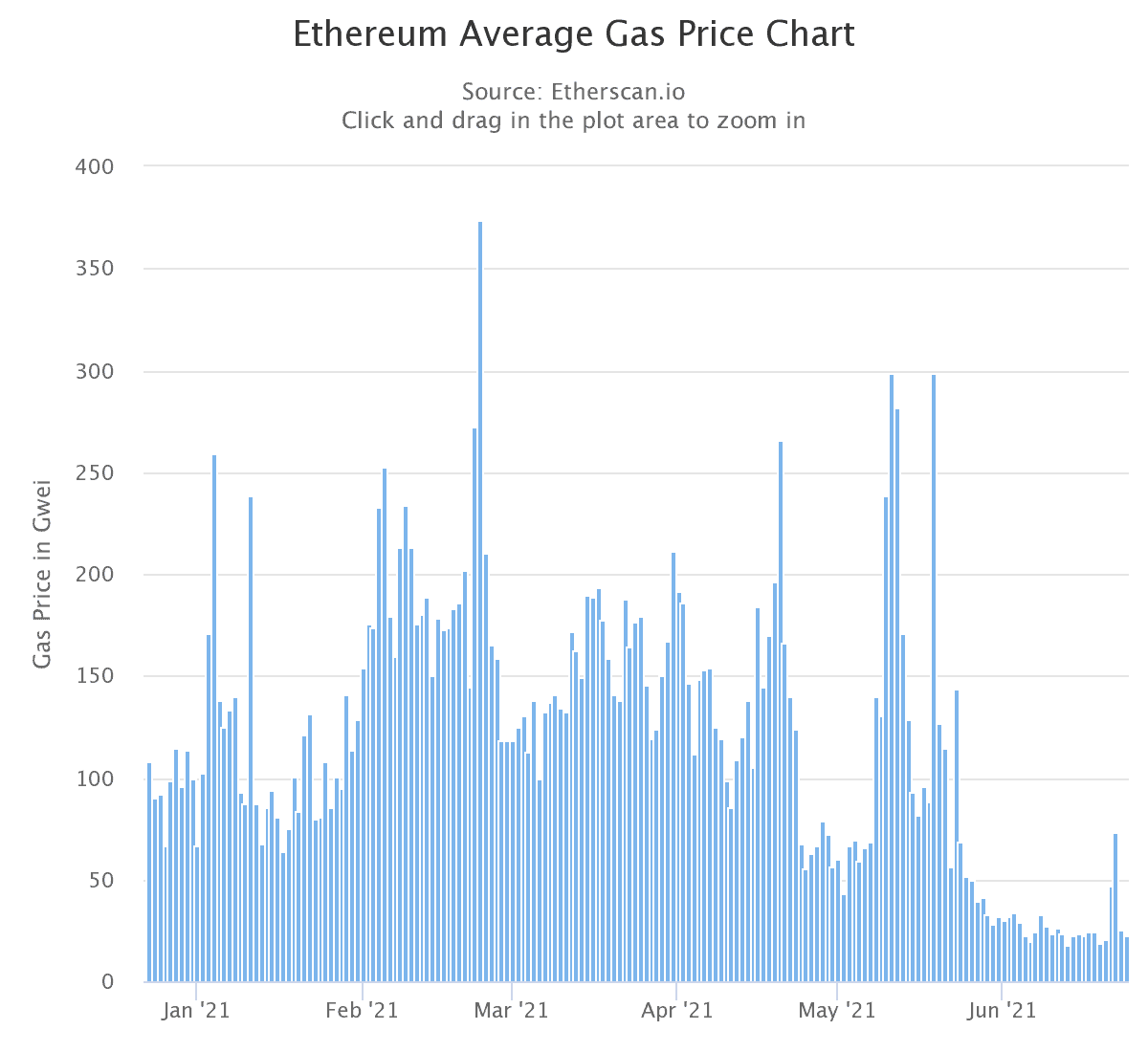
One possible explanation lies in the sharp correction in the overall market, led by the collapse of the key currency Bitcoin. This initially led to increased trading activity, which of course did not stop at the DeFi sector. The last spike in gas fees came on June 22nd, the day BTC made a detour below $ 30,000 .
Sidechains are helping Ethereum
However, the growing adoption of Layer 2 networks also provides additional relief for the Ethereum blockchain. Above all, Polygon (MATIC) stood out here. The sidechain has shown massive growth since April.
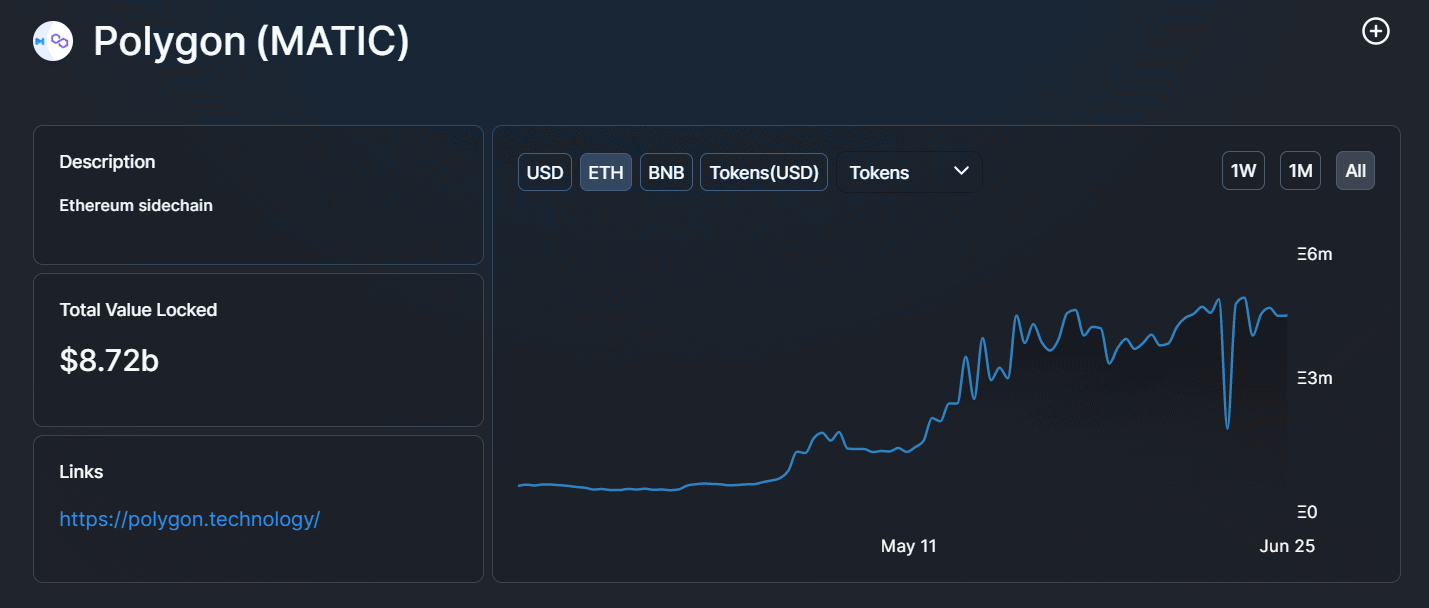
Especially in May, more and more investors have outsourced capital from the Ethereum blockchain to Polygon. This relief contributes in part to the lower gas fees.
EIP-1599 for more predictability
On June 22nd, however, it was recently shown that the increased use of sidechains does not protect Ethereum users from sharp fluctuations in transaction fees. This is where EIP-1599 could help with its automatically regulated base fee. However, it must be borne in mind that the miners do not benefit from the base fee - the base fee is destroyed, which increases the scarcity of ETH.
What is welcome for Hodler: inside represents an even greater incentive for miners to choose transactions with a big “tip” - and we have the same problem as with the current gas fee model. Therefore, it is primarily a question of whether the increase in the gas fee limit per block will be sufficient to ensure sufficient times of low occupancy so that users who can only pay a small tip or no tip at all to the miners, carry out their transactions quickly. The current test by EIP-1559 or London will soon provide new information in this regard.
My Top PicksHoneygain - Passive earner that pays in BTC or PayPal
BetFury - Stack BFG for daily dividends - Play smart!
Pipeflare - Faucet that pays in ZCash and Doge, Games pay in DAIWomplay - Mobile dApp gaming platform that rewards in EOSCointiply - The #1 Crypto Earning SiteLiteCoinPay -The #1 FaucetPay earner for LitecoinUpland - Collect Digital Properties & Test Your SkillsPublish0X - Earn Money By Writing and Reading Articles!LBRY/Odysee - YouTube Alternative that lets you earn Money by viewing videos!FaucetPay - The #1 Microwallet PlatformFireFaucet - An earning site that pays better for some than Cointiply
FREEBTC - The #1 FaucetPay earner for Satoshi's
FaucetCrypto - An earning/faucet site that pays out instantly
DogeFaucet - Dogecoin Faucet
xFaucet - BTC, ETH, LTC, Doge, Dash, Tron, DGB, BCH, BNB, ZEC, FEY - Claim every 5 minutes
Konstantinova - BTC, ETH, LTC, Doge, Dash, Tron, DGB, BCH, BNB, ZEC, USDT, FEY, 25 Claims Daily
Comments
Post a Comment